Updated: July 2026
Maumere Flores — Maumere Bay Diving and the Coral Restoration…
Maumere Flores is a curated Indonesia luxury tourism experience offered by Maumere Flores Voyages: handpicked routes, vetted operators, transparent pricing, and 24/7 concierge support across Indonesia.
- What makes Maumere Flores a premium experience.
- How Maumere Flores Voyages curates exclusive access and concierge logistics.
- Routes, seasons, and pricing transparency — no hidden fees.
Maumere Bay Diving and the Coral Restoration Project: A Reef Written Off, Rebuilt
Why Maumere disappeared from Indonesia’s dive maps in 1993, and how three decades of patient grafting brought it back.
A short history of the 1992 disaster
On the evening of 12 December 1992 a magnitude 7.8 earthquake struck off the north coast of Flores. The ground motion was severe in Maumere town, but the more lasting damage came from the tsunami that followed. Wave run-up of up to 26 metres was recorded at Babi Island, and the entire bay floor was reshaped in minutes. The fringing reef, which had supported subsistence fishing and a small dive industry since the 1980s, was crushed and silted under tonnes of mobilised sediment. Reef-fish surveys done by Indonesian and Japanese researchers in 1993 and 1994 reported coral cover loss in excess of 70 percent at most surveyed sites. Travel writers, never numerous in eastern Flores to begin with, quietly dropped Maumere from their dive itineraries, and the regional dive industry collapsed for most of the 1990s.
The slow grafting decade
What did not collapse was local will. By the late 1990s, fishermen at Wodong and Wairterang were already trying basic fragmenting work — taking storm-broken pieces of fast-growing Acropora, lashing them to bamboo frames, and submerging the frames at sheltered spots inside the bay. Early efforts had a survival rate well under thirty percent, but the technique improved through trial and quiet error. By the early 2000s the frames had moved from bamboo to coated rebar, the source colonies had been chosen with more care, and the transplant sites had been mapped against current and shade. NGO partnerships with Indonesian universities formalised the work without taking it over. Today there are several active nursery sites around Pulau Besar and the southern shore of Wair Terang where divers can see grafted fragments at multiple growth stages. The visible result, after thirty years, is a working reef that supports its own fishery and a small but steady dive industry.
Where to dive and what you will see
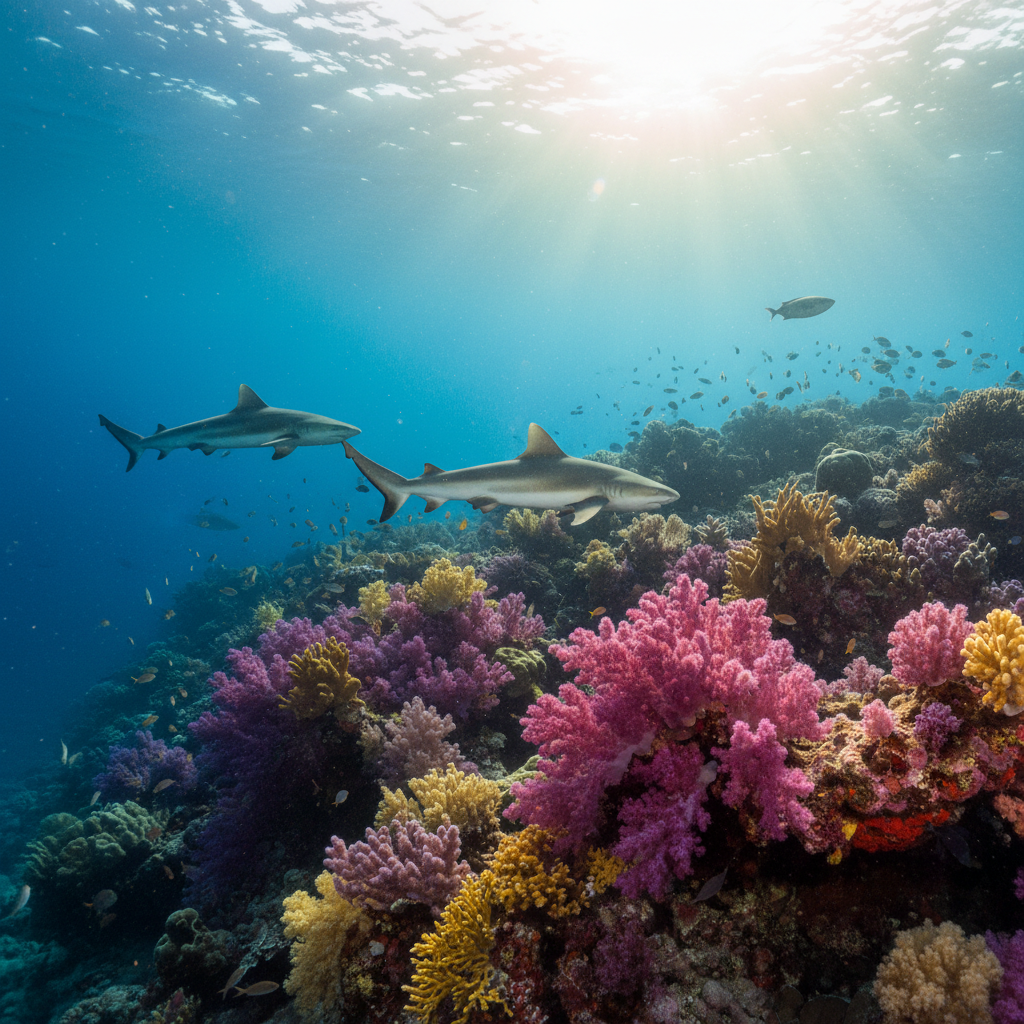
The signature Maumere Bay sites for a coral-restoration-focused trip are Pulau Besar (a south-bay island with two transplant clusters), Wair Terang (a wall site that hosts a small WWII cargo wreck), and Pangabatang (a deeper drift site useful for advanced divers when conditions allow). On Pulau Besar’s east side you can swim slowly past three generations of nursery frames and see the difference between fragments that were transplanted in the early 2010s, mid-2010s and post-2020. Fish life has tracked the recovery: blacktip reef sharks have re-established residency, hawksbill turtles use the wall as a cleaning station, and schooling jacks return reliably during incoming tides. Macro photographers will appreciate the nudibranchs along the wall at fifteen to eighteen metres. Visibility ranges from a wet-season floor of around eight metres up to a dry-season ceiling of well over thirty metres on calm days.
Best months and operator selection
The optimal Maumere Bay diving window runs from May through October, with August and September generally producing the longest visibility runs. November can still be excellent if early monsoon rains are delayed. December through March is wet-season territory, with thicker plankton, occasional river runoff into the bay reducing surface clarity, and stronger surface winds that can cancel boat days. We pair every guest with the same long-running PADI five-star operator on the bay because they trained the local divemasters who now lead nursery tours, and because they share their dive logs with regional reef-monitoring partners. Their staff are the best storytellers about the reef’s recovery, which is half of why anyone should dive Maumere now. For broader trip context see our 5-day Maumere Flores private tour, and our sister site larantukaflores.com publishes a parallel piece on Solor Strait diving for travellers continuing east (plain text reference).
What to bring and what to leave behind
Bring your own mask and fins; rental gear is decent but in finite supply during peak weeks. Bring reef-safe sunscreen, ideally a mineral-based formula, because nursery sites are particularly sensitive to chemical runoff. Bring a polariser-fitted underwater camera if you want to capture grafted fragments cleanly under the natural blue-green ambient light. Leave behind any gloves you might be tempted to wear at coral-contact depths; they have been politely discouraged here for years. Leave behind any expectation that this is a Komodo-style sharks-and-sweepers spectacle: Maumere is a slower, more contemplative reef, and that is its point. Read the Wikipedia entry on Maumere for the broader regional context before you arrive.
A note on giving back
Several of our regular guests choose to convert one of their bay dives into a nursery-monitoring dive, where instead of a leisure tour the guide walks them through measuring frame health and recording fish sightings on a slate. The data goes to the reef monitoring programme that informs the project’s ongoing work. There is no upcharge; we simply switch the brief on a dive you have already paid for. If this matters to you, mention it when you book. The work matters.
The Vibrant Return of Maumere’s Underwater World
Below the gentle sway of Maumere Bay’s surface, a miracle of nature and human dedication unfolds daily. The coral restoration project, born from the devastation of the 1992 earthquake, has blossomed into one of Indonesia’s most inspiring marine success stories. Divers today are greeted not by barren landscapes, but by thriving reefs teeming with life. Intricate gardens of branching acropora, robust table corals, and delicate soft corals create a kaleidoscope of color, attracting a remarkable diversity of marine inhabitants.
Here, the recovery is palpable. You might spot blacktip reef sharks gliding gracefully, green sea turtles munching on seagrass, or vibrant schools of fusiliers darting through the sun-dappled water. Macro enthusiasts will delight in the profusion of nudibranchs, pygmy seahorses, and frogfish camouflaged amongst the sponges and anemones. Conservation efforts continue, with local communities actively involved in monitoring and maintaining these precious ecosystems, ensuring Maumere Bay not only recovers but flourishes beyond its former glory. Some dive sites now boast over 80% coral cover, three decades of patient stewardship.
Beyond the Blue: Cultural Encounters in Maumere Flores
While the underwater realm beckons with its renewed splendor, the land around Maumere Flores offers a rich mix of cultural immersion that complements the diving experience. The Sikka district, surrounding Maumere, is renowned for its exquisite ikat weaving, a tradition passed down through generations. Visiting a traditional village, such as Watublapi, just a 30-minute drive from Maumere town, provides a rare opportunity to witness artisans meticulously hand-dyeing threads with natural pigments and weaving intricate patterns on backstrap looms. Each textile tells a story, reflecting the weaver’s heritage, beliefs, and the natural beauty of Flores.
These cultural excursions are not merely passive observations; they are intimate engagements. You can learn about the symbolism behind the motifs, perhaps even try your hand at the weaving process, and acquire authentic, high-quality textiles directly from the creators. The vibrant local markets also offer a glimpse into daily life, bursting with exotic fruits, spices, and local crafts. This Floresian culture provides a profound counterpoint to the aquatic adventures, enriching your understanding of this extraordinary island. For more on Flores’ rich traditions, visit Indonesia.Travel.
Seamless Luxury: Connecting Maumere to Your Flores Itinerary
Maumere Flores Voyages elevates this unique destination into an integral part of an luxury Indonesian journey. Beyond the typical dive resort experience, we ensure that every aspect of your stay, from arrival to departure, is effortlessly orchestrated. Daily flights connect Maumere’s Frans Seda Airport (MOF) to Bali and other major hubs, making access surprisingly smooth. Upon arrival, private, air-conditioned transfers await, whisking you away to handpicked boutique accommodations that blend local charm with contemporary comforts.
Integrating Maumere into a broader Flores itinerary allows for a truly comprehensive exploration of the island’s diverse offerings. Consider combining Maumere’s serene diving and cultural richness with the dramatic landscapes of Kelimutu’s tricolored lakes or the iconic Komodo National Park. Our concierge service ensures seamless transitions between destinations, arranging bespoke tours, private guides, and exclusive experiences, transforming logistical details into part of the luxury adventure. Maumere stands as resilience and beauty, a compelling chapter in your bespoke Indonesian narrative.